Sustainable environment, free flying and occasional fun.
Joint US/China statement 13/04/2013:
The U.S.A. and the People's Republic of China recognize that the increasing dangers presented by climate change measured against the inadequacy of the global response requires a more… urgent initiative... Both sides consider that the overwhelming scientific consensus regarding climate change constitutes a compelling call to action crucial to having a global impact on climate change.
New from the "Story of Stuff" project. Last year the US supreme court ruled that US corporations should have the same rights as people, using a bizarre twisting of the meaning of their Constitution. Is that a problem? You betcha!
Annie “Story of stuff” Leonard also came up with another pocket gem a while back (November 2010) which I forgot to publicise at the time.So here it is now (click this link for further info).
Here’s a blog post on water/future droughts from Joe Romm of Climate Progress
New study puts the ‘hell’ in Hell and High Water Must-read NCAR (National Center for Atmospheric Research) analysis warns we risk multiple, devastating global droughts even on moderate emissions path.
And next an article from Reuters which draws attention to the risks investors face -
SANDRA POSTEL & ELIZABETH ROYTE discuss why water footprints are so important and what people can do to reduce the amount of fresh water they use. Sandra Postel is Water Fellow at Post Carbon Institute and National Geographic's first Fresh Water Fellow. She directs the independent Global Water Policy Project and is the author of numerous books and reports about international fresh water issues. Elizabeth Royte is a journalist and science/nature author. She is best known for her books Garbage Land, The Tapir's Morning Bath: Solving the Mysteries of the Tropical Rain Forest and Bottlemania: How Water Went on Sale and Why We Bought It. *note: Due to Sandra's location on a mesa in New Mexico, her video feed is intermittent and choppy.
Impressive figures next but beware of the super-cheesy grin at the end of this info-advertisement!
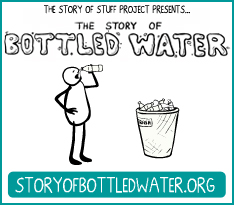
All over the environmental blogosphere recently is the launch of “The Story of Bottled Water”. Slightly more relevant to the US than Europe it nevertheless holds up the relatively new industry of selling water to us, in a very expensive form, to ridicule. It dissects the way marketing organisations twisted the public’s perceptions so that money could be extracted from them unnecessarily.
March 22nd is recognized as World Water Day, whose goal is “Clean Water for a Healthy World.” Sound simple? Well it’s not. If you live in a community where you have access to clean water at the turn of the tap, then you are lucky.
And if you do have access to clean potable water, then why are you buying bottled water?
Annie Leonard is famous for her 20 minute short video “The story of Stuff”. Well here us her latest effort “The story of Bottled water (click this link for the bottle water website)
Jersey Climate Action Network has, as one of its campaign targets for the year, the reduction in the over-use of throw away container bottled water. For sustainable reason for waste reduction reasons and finally for litter reduction reasons (and finally, finally for B.S and ultra pretentiousness reduction reasons!).
When I used to write the Jersey Friends of the Earth newsletter in the 90’s, I would have a feature called Snippets whereby I would highlight lots of different stories in shortened form. There really is too much to keep up with environmentally nowadays so I will be doing the same “feature” every now and again. Here is the first. Snippets Snippets Snippets Snippets Snippets Snippets
Champagne Charlies will notice a difference soon! Champagne bottles are going to be slimmed down for the environment. The bottles are as heavy as they are to contain the high pressure of the CO2 gas inside but they are being redesigned to lose excess glass and thereby lighten up. link to triplepundit.com article about champagne bottles
-----------------------------------------------------------------
Genetically modified crops are touted as a saviour for global food production by increasing food yields, reducing pesticide use etc.
The India Times reports that the cotton boll worm has already developed resistance to Monsanto’s BT cotton. Monsanto are now pushing BT cotton 2 – the sequel - so yet another treadmill of increasing tech “solutions” and subsequent failure is born –they are even criticising the farmers! Ironically cotton yields are falling and pesticide use is increasing which is exactly what GM crops were promised to do – not!
Technology probably won’t be enough to stave off the forthcoming difficulties in feeding the world. Initial successes of the “Green revolution” are looking a bit jaundiced now. http://www.hindu.com/2009/09/26/stories/2009092658910100.htm http://www.nytimes.com/2009/10/22/world/22food.html?th&emc=th
-----------------------------------------------------------------
Just for those who say there is no point in the West doing anything about CO2 emissions because China is building a new coal plant every week… When you know the other side of the story, that the denialists “accidentally” leave out, you might not be so cocky. Also this story and this one show that those voices in America who argue against investing in renewables as pointless because “China will never do it” are dangerously misled/misleading. China will get to a sustainable energy supply system far in advance of the USA, not to mention a huge competitive advantage.
-----------------------------------------------------------------
Plastics used in food containers often contain Bisphenol-A – a plastic additive that has got a lot of bad press recently. This latest research report might sound the death knell for the routine widespread use of this substance which is so prevalent in plastic bottles, food cans etc.
I was caught out myself because my beloved Sigg water bottle has a lining that proved to contain Bis-A. Sigg have apologised and have set up a “return and replace” initiative. Their new water bottles do not contain this chemical. http://www.environmentalhealthnews.org/ehs/newscience/human-placental-cells-die-after-bpa-exposure/
As if that wasn’t enough, Bis-A might have a hand in the tidal wave of obesity that assaults us in every other reality TV programme out there. This Newsweek article suggests that hormone mimicking chemicals, such as Bis-A, might engender excess fat cells in the very young. Tributyltin may also be an “obesogen” that causes more fat cells. So too some phthalates (used to make vinyl plastics, such as those used in shower curtains and, until the 1990s, plastic food wrap), and perfluoroalkyl compounds (used in stain repellents and nonstick cooking surfaces).
-------------------------------------------------------------
Things that make you go hmmm…
Extract from Simple Earth media blog follows: “Now tobacco may be able to redeem itself by producing solar cells, according to researchers at the University of California at Berkeley. By infecting tobacco plants with a genetically engineered virus, scientists have been able to “produce artificial photovoltaic and photochemical cells” which are biodegradable and may end up being “more environmentally friendly than traditional methods of making solar cells”.” Grow your own solar cells - tobacco now healthier!
----------------------------------------------------------------------------
Annie Leonard is the face and voice of “The Story of Stuff” which I’ve linked to and talked about several times before. It’s simply great. Here she is live at Bioneers 2009
-----------------------------------------------------------------------
There are very significant moves afoot for companies to clean up their environmental act and become more sustainable.Here’s some links to how some of the biggest are getting on. How a Subaru plant achieved a zero landfill status
Walmart sustainability summit (2007)
“The main event was a speech by CEO Lee Scott in which he stated in no uncertain terms that Wal-Mart is in this for the long haul, and expects its suppliers to be in it for the long haul too. Scott pointed out that while his company is aiming for zero waste and 100% renewable energy, this still only accounts for 8% of its footprint, and that Wal-Mart must green its supply chain if it has any chance of becoming sustainable”
-------------------------------------------------------------------------
Just in case anyone still believes that global warming is all a hoax or something cooked up by Al Gore to make money, just see how far back the warnings went.
---------------------------------------------------------- Nicolas Sarkozy has proposed a “joie de vivre” index to complement/replace GDP. Like Bhutan’s happiness index and similar indicators, from such as the New Economics Foundation, these initiatives posit that simply measuring GDP is a very poor (sometimes literally) way of measuring what people really value. A lot of political effort is expended on improving GDP figures because that is the current measure of “economic” success unfortunately the consequences that follow often conflict with peoples’ sense of well being.
---------------------------------------------------------------------
There are moves to tax sugary fizzy drinks in the States – Coca Cola watch out! http://www.triplepundit.com/2009/10/tax-on-soft-drinks-could-relieve-states-budget-woes/
-----------------------------------------------------------------
Algae as a productive source of biofuel is now being seriously investigated. Like much research in renewable energy, we have lost 3 decades worth of time because of the yuppy/Republican years when the world ignored what was necessary and went on a consumerist binge literally fuelled by cheap oil. This story shows that algae was being investigated as far back as the Jimmy Carter years before subsequent political developments pulled the funding plug which caused some of the genetic legacy of suitable candidate organisms to be lost in the subsequent Bush type administrations, although Clinton bears some responsibility.
---------------------------------------------------------------------
Do compact fluorescents use more energy than incandescents if manufacturing is taken into account? Life cycle analyses show that both LED and compact fluorescent bulbs are not even close. Both technologies use much less energy in total.
---------------------------------------------------------------------- Insurance companies throw in the towel
Taken from the greenlivingideas.com website Property insurance may no longer be available in the future if we can’t get control of climate change, says Nick Starling, the Director of General Insurance and Health for the Association of British Insurers. Climate change could end the continuing availability of property insurance.
The insurance industry might be overwhelmed by losses and no longer be able to pay out for property losses with increased climate change, the Association of British Insurers announced this week.
Having examined scientific research commissioned by the British Meteorological Office, the ABI found that even the minimum of 3.6 degrees Fahrenheit rise in global average temperatures (2 C) would increase annual British property losses to $77 million from inland flooding and windstorms.
A global average temperature rise of 10.8 F (6 C) was also played out in scenarios, along with average global rise of 7.2 F (4 C) as well. At those levels the Director of General Insurance and Health for the Association of British Insurers said property insurance would simply no longer be possible for the insurance industry, which depends on actuarial history to determine risk.
Humanity is now moving completely outside of risk levels associated with human history.
---------------------------------------------------------------------------
Magnus Larsson: Turning dunes into architecture
This is a somewhat wacky, but highly creative idea, which involves forming desert sand dunes into buildings. A liquid is injected in a 3D pattern which solidifies the sand into a sort of concrete. Loose sand is removed and Bob’s your Uncle! Spectacular buildings
------------------------------------------------------------------
Reprinted from the wonderful Inhabitat – design will save the world – website
Scientists at Genomatica Inc. recently announced (click for original article) that they have developed strains of bacteria that are able to produce plastic without the use of oil or natural gas. The sustainable process utilizes little more than sugar and water to produce butanediol (BDO), which can be manufactured into everything from plastics and fibers to pharmaceuticals. Genomatica estimates that within a year the energy-efficient process will cost less than current hydrocarbon-based processes – a revolutionary development since close to 3 billion pounds of BDO are manufactured each year.
-------------------------------------------------------------------
Peak oil – we’re probably there already. The world is much closer to running out of oil than official estimates admit, according to a whistleblower at the International Energy Agency who claims it has been deliberately underplaying a looming shortage for fear of triggering panic buying. http://www.guardian.co.uk/environment/2009/nov/09/peak-oil-international-energy-agency/print
I posted a long comment (comment #4) on this article on triplepundit.com, so I thought I would re-use it here, with a little editing.
The article linked to above was a critique of Annie Leonard’s new video “The Story of Cap and Trade” which is a very harsh criticism of carbon “cap and trade” - it basically suggests that it would all be too corrupt and useless to be worth it. This particular market mechanism is seen by many as a way of getting the “free” market to take action to avoid the worst of the problems that climate change will bring.
Annie was responsible for the wildly successful viral video “The Story of Stuff” which held our ever increasing consumer society up to the light for examination – consumerism was found seriously wanting (wordplay intended!).
I am a great fan of "The Story of Stuff" and have linked to it several times here to enhance a point I was making. The film was clear and made extremely good points. It deservedly became very popular. I did not like the "Story of Cap and Trade", although Annie is still loveable in it. It seemed as if Annie was letting an ideology blind her to the potentially overwhelming usefulness of the concept - the baby was thrown out with the bathwater - worse, she constantly suggested that either there was no baby or it would grow up to be an evil adult.
Her point about how the virtually unregulated simple market has forced us towards our current dire predicament is, of course, accurate. She goes from this point, in a pseudo-logical fashion, rather like this: markets have brought us to this point - this point is bad - therefore any further market based solution will also be bad - therefore she must then exploit the credibility and warm fuzzy feelings that people remember from "Story of Stuff" to show them that market based "cap and trade" will inevitably be a bad thing.
The problem with markets (up to date) is that their bottom line only contains measurements of money in versus money out and unfortunately the processes that make the money do not take "externalities" into account such as carbon emissions, volume of waste generated, general non-sustainable damage to the environment, reduction in bio-diversity, public health, social well being etc. etc.
The damage that economic activity/growth inflicts on these "externalities" can be (if we're lucky) controlled and moderated by legislation and voluntary codes of practice but the problems are systemic and huge and legislation is a very slow and blunt weapon - sadly, the legislators also tend to be high up members of the same society, with the same set of values, that created the situation in the first place by not valuing the environment or social values enough. Expecting them to lift themselves up by their own bootstraps (by re-evaluating everything that is familiar and comfortable to them) is optimistic to say the least.
Concerted campaigning and citizen action can generate enough pressure to compel some companies to adopt a greener, more sustainable, outlook but it's not enough. The company that continues to maintain a cavalier approach will mostly tend to be more profitable; that is the problem with markets-to-date. Putting the full costs, financial, environmental and social onto the accountants' bottom line will have an extremely powerful, almost automatic, effect that will drive companies and economies to "do the right thing" because, if they don't, they will become less profitable or go out of business altogether.
Markets have historically been bad for sustainable ways. Putting a cost/value on carbon emissions (and all the other externalities too - but that's for later...) that will direct greedy people to be keen to take the green option - purely to save money - will be a great start - it may just solve the whole shooting match.
Annie's basic premise is to suggest that any market will end up being totally corrupt. Well, it's up to us to keep them straight - she can't just point to teething problems or far-fetched theoretical dangers to reject the whole idea. The bad possibilities she enumerates are there because we have had a whole generation of enthusiastic "yuppies", with their selfish short term outlook, driving the market mechanisms to Madoff like breaking points. It was in their financial (short to medium term) interests to do so! Change the financial interests of people like that - make it (not) so!
Monetise the externalities - put considerate, wise, prudent, sensible environmentally and socially sound economic drivers onto the bottom line and watch society transform itself far faster and more efficiently than even the most draconian legislation could do. Watch people's personalities and the world zeitgeist change too.
Nothing big ever worked right first time - it will take a lot of effort, tuning and tweaking and monitoring to hack it into shape but imagining that markets, that were predisposed to generate corrupt selfish greedy types, who don't care about anything apart from their own "bottom line", must always do that is truly throwing the fantastic baby out with the murky water.
A market which uses full cost (or ecological or environmental) accounting would be transformative and constructive, not destructive. It all depends what you measure when you tot up the bottom line. Make the bad guys, environmentally and socially, less profitable. Make the good guys more profitable. Make it so!
 New from the "Story of Stuff" project. Last year the US supreme court ruled that US corporations should have the same rights as people, using a bizarre twisting of the meaning of their Constitution. Is that a problem? You betcha!